
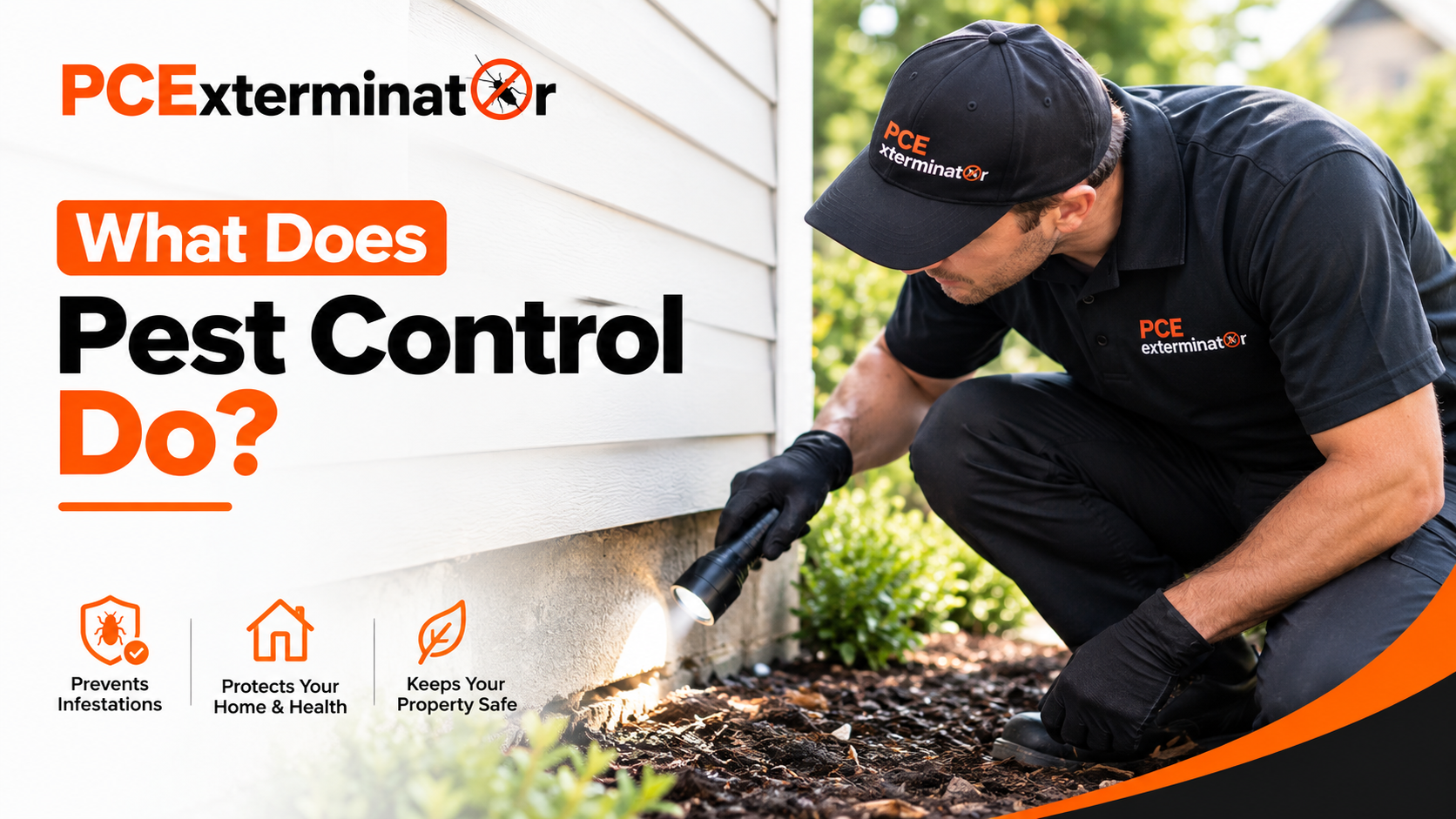
Most people picture pest control as one thing: a technician with a sprayer walking the baseboards. That is maybe fifteen percent of the job. The rest is finding out how pests got in, what is keeping them there, and closing the door behind them.
What Does Pest Control Do? The Short Answer
Pest control identifies a pest species, locates where it lives and breeds, removes the existing population, and then changes the conditions that let it in. Killing bugs is one step out of four, and it is rarely the step that decides whether the problem comes back.
A complete service covers four jobs:
| The Job | What It Actually Means |
| Identification | Confirming the exact species, because treatment differs by species |
| Inspection | Finding harborage, food, water, and entry routes |
| Treatment | Applying baits, residuals, dusts, traps, or heat where pests actually travel |
| Exclusion and prevention | Sealing gaps, correcting moisture, and scheduling follow up |
That is the difference between a professional visit and a can of store bought spray. The can handles step three only, and step three alone almost never holds.
Takeaway: if a company arrives, sprays, and leaves in ten minutes without asking you a single question, you did not buy pest control. You bought spraying.
What Is Pest Control, and How Does Pest Control Work?
Pest control is the managed reduction of a pest population to a level where it no longer threatens health, property, or comfort. The working framework across the US industry is Integrated Pest Management, usually shortened to IPM.
IPM works on a simple principle: pests are a symptom. A cockroach population is not a random event, it is a response to available food, moisture, warmth, and shelter. Remove the reason and the population collapses. Spray without removing the reason and you get a temporary dip followed by a rebound.
So a licensed technician works in this order:
- Identify the species and confirm it with evidence, not guesswork
- Inspect to map harborage, travel routes, and entry points
- Set a threshold for what level of activity requires action
- Apply the least invasive effective method first, chemical last where possible
- Monitor with traps and follow up visits to confirm the population is dropping
- Correct conditions so reinfestation has nothing to feed on
Why the Inspection Matters More Than the Spray
Two homes can report “ants in the kitchen” and need completely opposite treatments. Odorous house ants need a slow acting sweet bait carried back to a colony you never see. Carpenter ants need the nest found, because bait alone often will not reach it, and the nest may sit in a wet roofline twenty feet away.
Same complaint. Same room. Different job entirely. That is why <u>PC Exterminators</u> technicians inspect before quoting rather than pricing off a phone description.
What Pests Does Pest Control Treat?
Professional pest control services in the US cover roughly fifty common species across five categories. Most companies handle all of them, with wildlife and fumigation sometimes requiring a specialist license.
Crawling insects: cockroaches, ants, silverfish, earwigs, centipedes, crickets, beetles
Flying insects: mosquitoes, flies, wasps, hornets, gnats, moths
Wood destroying pests: subterranean termites, drywood termites, carpenter ants, carpenter bees, powderpost beetles
Rodents and wildlife: house mice, roof rats, Norway rats, squirrels, raccoons, opossums, bats
Parasitic and biting pests: bed bugs, fleas, ticks, mites, spiders
Wood destroying pests sit in their own tier because they carry structural and financial consequences rather than nuisance ones. Termite work is typically licensed separately, quoted separately, and inspected on a different schedule than general pest service.
The Species Question People Skip
Ask your technician to name the species, not the category. “Roaches” is not an answer. German cockroaches breed indoors and need aggressive baiting. American cockroaches usually come from a drain, sewer line, or crawlspace and need a plumbing fix as much as a treatment. Treating one like the other wastes months.
Pest Control Methods: What the Work Actually Involves
Here is what does pest control do in physical terms, method by method. Very little of it is broadcast spraying.
| Method | What It Is | Typically Used For |
| Crack and crevice application | Liquid or aerosol injected into gaps under an eighth of an inch | Roaches, ants, silverfish |
| Gel and granular baiting | Slow acting bait carried back to the colony or nest | Ants, German cockroaches, some rodents |
| Void dusting | Fine dust blown into wall cavities through utility openings | Roaches, ants, stinging insects |
| Residual perimeter banding | A treated band along foundations, thresholds, and baseboards | General prevention, spiders, crawling insects |
| Trapping and exclusion | Snap traps, multi catch traps, sealing with steel and mesh | Mice, rats, wildlife |
| Growth regulators | Products that stop insects reaching breeding maturity | Fleas, roaches, stored product pests |
| Heat treatment | Raising a room to lethal temperature, roughly 120 to 135 degrees | Bed bugs |
| Termite baiting and soil barriers | In ground stations or a treated soil zone around the structure | Subterranean termites |
| Habitat and moisture correction | Fixing leaks, grading, drainage, and vegetation contact | Nearly every recurring problem |
Notice that the last row is not a product at all. Roughly a third of what a good technician does on a visit involves no pesticide whatsoever: sealing a pipe collar, pointing out a downspout dumping against the foundation, recommending a dehumidifier for a crawlspace.
Takeaway: the best pest control methods for your property depend on the species and the structure, not on which product the company happens to stock.
What Happens During Pest Control: A Real Visit, Step by Step
A first residential visit typically runs 45 minutes to 2 hours. A preventive maintenance visit runs 15 to 45 minutes. Here is what pest control treatment involves in practice.
Interview (5 to 10 minutes). What you have seen, where, when, and how often. Whether there are children, pets, pregnancy, asthma, or fish tanks. This conversation changes product selection before anything is mixed.
Interior inspection (15 to 30 minutes). Under sinks, behind and beneath appliances, inside cabinets, along baseboards, around plumbing penetrations, into utility closets, attic and crawlspace access where available.
Exterior inspection (10 to 20 minutes). Foundation cracks, weep holes, utility penetrations, door sweeps, window seals, roofline, gutters, standing water, mulch and vegetation contact with siding.
Treatment (15 to 45 minutes). Targeted placement based on what the inspection found. Baits into voids, dust into wall cavities, residual bands where crawling insects travel, traps where rodent evidence appeared.
Exclusion work (varies). Sealing gaps with copper mesh, foam, or sealant. Some companies include minor exclusion, others quote it separately. Ask before booking.
Documentation and debrief (5 minutes). A written service report listing every product applied, the amount, the location, the target pest, and the re-entry interval. This is a legal requirement in most states, not a courtesy.
If nobody hands you a report, ask for one. It is the only record you have if a dispute comes up later.
Does Pest Control Kill Bugs, or Prevent Them?
Both, but they are separate services sold under one name, and confusing them is the single most common reason people feel their treatment failed.
| Pest Removal | Pest Prevention | |
| Goal | Eliminate an active infestation | Stop one from establishing |
| Trigger | You have seen pests | Scheduled, seasonal, or after a move |
| Visit length | Longer, often multiple visits | Short, 15 to 45 minutes |
| Product volume | Higher, targeted at harborage | Lower, mostly exterior perimeter |
| Timeline | 2 to 6 weeks for full results | Ongoing, no visible “result” |
| Success looks like | Activity drops to zero | Nothing ever happens |
Pest prevention services are harder to appreciate precisely because success is invisible. Nothing happening is the product. Most recurring residential plans are 80 percent prevention and 20 percent removal after the first two visits.
<u>PC Exterminators</u> connects homeowners with local technicians who handle both, whether you need one emergency visit or a year round plan.
What to Expect After Pest Control
This section prevents more unnecessary callbacks than any other, so it is worth reading before your first visit.
You will probably see more bugs, not fewer, for the first one to two weeks. This is called the flush effect, and it is the treatment working. Residuals and dusts push insects out of the wall voids and cabinet cavities where they normally hide. They come into the open, into your line of sight, and die there. Seeing dead and dying roaches on your kitchen floor on day three is evidence of success, not failure.
Timeline for most general treatments:
- Days 1 to 3: visible activity increases as pests are flushed from harborage
- Days 4 to 14: activity drops sharply as bait is shared through the colony
- Weeks 2 to 4: activity should reach near zero
- Weeks 4 to 6: follow up visit targets any newly hatched generation
What to do after treatment:
- Do not mop, scrub, or wipe treated baseboards and cabinet interiors for at least two weeks
- Leave bait placements and traps completely undisturbed
- Vacuum open floors normally, that does not affect the treatment
- Keep pets away from treated areas until surfaces are fully dry
- Write down where you still see activity and when
- Report increasing activity after week three, not week one
The mopping rule matters more than people expect. Residual products are engineered to stay on the surface so insects pick them up over days of contact. Washing them off the same evening removes the treatment you paid for.
How Long Does Pest Control Last?
Residual products are deliberately designed to break down. If they did not, they would persist in your home and in the environment indefinitely, which is exactly what modern EPA registration is written to prevent. Degradation is a safety feature.
| Treatment Type | Typical Effective Duration |
| Interior residual spray | 30 to 90 days |
| Exterior perimeter treatment | 30 to 60 days, less in heavy rain or heat |
| Gel bait placements | Until consumed or dried out, roughly 30 to 90 days |
| Rodent bait stations | Ongoing with monthly or quarterly servicing |
| Bed bug treatment | Indefinite if fully eradicated, usually 2 to 3 visits |
| Termite soil barrier | 5 to 10 years depending on product and soil |
| Termite bait system | Indefinite with ongoing station monitoring |
| Mosquito barrier treatment | 21 to 30 days |
Sunlight, rain, humidity, foot traffic, and cleaning all shorten these windows. An exterior perimeter treated in Texas in August will not last as long as the same product applied in a dry October.
How Often Should Pest Control Be Done?
Frequency depends on property type, climate, and pest pressure rather than on a universal rule.
Quarterly suits most single family homes in moderate climates. Four visits a year keeps a residual barrier in place through each seasonal shift.
Bi-monthly suits homes in warm, humid regions, properties backing onto woods or water, and anywhere with a history of recurring pressure.
Monthly suits active infestations, food handling businesses, multi unit buildings, and any property under audit requirements.
Annually is enough for termite inspections on protected structures, plus a general inspection before buying or selling a property.
Commercial properties almost always need more frequent service than homes. They receive deliveries, host constant foot traffic, and generate more waste, which means more introduction events per month.
How Effective Is Pest Control, and What It Cannot Do
Professional treatment resolves the large majority of common household pest problems within one to two visits when the underlying conditions are also addressed. Effectiveness drops sharply when they are not, and being honest about that is more useful than a guarantee.
Pest control cannot fix:
- A roof leak, a failed drain line, or a crawlspace with standing water
- Structural gaps that were never sealed after the last treatment
- Sanitation conditions that keep replenishing the food supply
- Neighboring units, buildings, or properties that go untreated
- Existing structural damage from termites or rodents, that is a contractor’s job
- Reinfestation carried in on luggage, secondhand furniture, or a pet
If your technician tells you the treatment will not hold until you fix a leak or seal a foundation gap, that is not an upsell dodge. It is the most valuable thing they will say all visit.
How to Tell If Your Treatment Worked
- Activity dropped steadily after week two rather than staying flat
- You received a written report naming products, locations, and target pests
- Entry points and moisture issues were identified, not just sprayed past
- A follow up visit was scheduled before the technician left
- The technician could name the species, not just the category
What Does a Pest Control Company Do Beyond Treatment?
A licensed company carries obligations that a DIY approach simply does not.
- Holds state licensing and applicator certification, renewed with continuing education
- Carries liability insurance and, in most states, bonding
- Applies EPA registered products strictly at labeled rates, which is federal law
- Maintains service records and pesticide application logs
- Provides re-entry intervals and safety guidance in writing
- Offers retreatment guarantees between scheduled visits
- Handles pest inspection and treatment documentation for real estate transactions
On the naming question people search constantly: in the modern US industry, “exterminator” and “pest control company” describe the same licensed professionals. The distinction some marketing pages draw between the two is mostly branding. Judge a company by its licensing, its inspection process, and its written reporting, not by the word on the truck.
When to Hire Professional Pest Control Services
Handle it yourself for a single wasp, a few pantry moths, or one ant trail with an obvious source. Call a professional when any of these apply:
- The same pest returns within weeks of your own treatment
- You see cockroaches during daylight hours, which indicates a large population
- You suspect termites, carpenter ants, or any wood destroying activity
- Rodents are present, since droppings and urine are a genuine health hazard
- Bed bugs are suspected, as DIY treatment reliably makes these worse
- Stinging insects have nested in a wall, roof, or anywhere hard to reach
- Anyone in the household has asthma, allergies, or immune vulnerability
- You are buying, selling, or moving into a property
Searching for pest control near me at 11pm on a Sunday is a common way this starts. <u>PC Exterminators</u> operates 24 hours a day and connects you with licensed, bonded, and insured local technicians for both residential pest control services and commercial properties across all 50 states.
FAQ: What Does Pest Control Do?
What does pest control do, in simple terms? It identifies the pest species, inspects for harborage and entry points, treats where pests actually live and travel, then seals and corrects the conditions attracting them.
Does pest control kill bugs immediately? Some contact products work within minutes, but baits are deliberately slow so insects carry them back to the colony. Full results usually take two to four weeks.
How does pest control get rid of pests permanently? Nothing is permanent without exclusion. Lasting results come from sealing entry points, correcting moisture, removing food sources, and maintaining a scheduled service plan.
What happens during pest control at my home? An interview, an interior and exterior inspection, targeted treatment based on findings, minor exclusion work, and a written report listing every product applied.
How long does pest control last? Interior residuals last 30 to 90 days, exterior perimeter treatments 30 to 60 days, and termite barriers 5 to 10 years. Weather and cleaning shorten these windows.
How often should pest control be done? Quarterly suits most homes. Bi-monthly suits humid climates and high pressure properties. Monthly suits active infestations and commercial properties under audit requirements.
Does pest control prevent pests or just remove them? Both, as separate services. Removal clears an active infestation. Pest prevention services maintain a barrier and correct conditions so infestations never establish.
How effective is pest control compared to DIY? Professionals identify species correctly, access licensed products, and treat harborage rather than surfaces. DIY treatment commonly scatters populations and delays real resolution.
Ready to Find Out What Pest Control Can Do for Your Property?
Now you know what a real visit involves: identification, inspection, targeted treatment, exclusion, and a written record of every step. <u>PC Exterminators</u> connects homeowners and businesses with licensed, bonded, insured local technicians who work that way on every visit, whether you have one stubborn ant trail or a building wide problem.
Free inspection. Straight answers. A custom quote with no pressure and no obligation.
| Contact | Detail |
| Phone | +1 855 616 1287 |
| info@pcexterminator.com | |
| Hours | Open 24 hours, 7 days a week |
| Coverage | All 50 US states, same day service in most areas |
| Guarantee | 100% satisfaction, in writing |